Advertorial

HEALTH & WELLNESS MAGAZINE

HEALTH & WELLNESS MAGAZINE
Home › Bladder health › Help for bladder leakage
Leading Australian urologist: "This is the fastest and easiest way to get rid of women's bladder leaks and sudden urges to rush to the toilet – once and for all"

Emma de Vries | 20 september 2024
A former long-term bladder sufferer reveals the costly trap of pads and liners that can cost around A$3,000 a year – and the discovery that helped her patients put an end to bladder leaks, sudden toilet urges and interrupted sleep without medication, surgery or a single pelvic floor exercise.

3,791 Reviews

I'm about to make myself unpopular with a lot of GPs, gynaecologists and pharmaceutical representatives across Australia.
Because what I'm about to tell you could cost the bladder health industry millions of dollars in lost sales from pads, liners and prescription products.
But I don't care.
After twenty years of giving women the same unhelpful answers…
After watching them quietly adjust their lives around a problem I told them was simply a normal part of getting older…
After discovering that much of what I was trained to say was, at best, incomplete. And at worst, it was helping keep them trapped in the problem.
I no longer worry about the politics behind it.
My name is Dr Susan Mitchell.
I'm a urologist and have spent the past twenty years working in women's health.
And now I'm going to tell you what I should have told every woman who has ever sat across from me in my consulting room.
If you're reading this and planning every outing around where the nearest toilet is…
Then you know exactly how it feels.
The next few minutes could change the rest of your life.
Because I'm going to show you exactly why everything you've tried so far hasn't worked.
Why the standard treatment approach is designed to help you manage the problem forever — not get rid of it.
And which approach actually works. For women who have been suffering in silence for years.
Let me tell you about a woman who said exactly the same thing.
The day I started questioning everything.

Her name was Margaret.
She was 69 years old when she finally came to see me.
What I remember most isn't what she told me. It's how long she had waited to say it.
Seven years.
Seven years of bladder leaks. Seven years of buying pads and liners in silence, sometimes hidden among other items in her online shopping basket. Seven years of planning every car trip, every family gathering and every church service around where the nearest toilet was.
Then one afternoon, while she was waiting in line at Woolworths, she felt that familiar sensation.
No one around her noticed a thing.
But as she sat in her car afterwards, she had a thought she couldn't shake:
I can't keep living like this.
So she booked an appointment.
I gave her the usual advice. Pelvic floor exercises. A prescription. Drink less. Come back in three months.
She nodded. Thanked me. Left.
And I sat there staring at her medical file and thinking:
"Am I actually right? Or have I just been repeating the same unhelpful advice for twenty years?"
I spent the next six months searching for the answer.
What I discovered made me wish I could call every patient I'd ever sent home with that advice and apologise.
The surprising discovery.

The morning after Margaret came to see me, I started digging deep into the research.
Medical journals were spread all over the kitchen table. Cold cups of coffee were sitting everywhere. My husband would bring me dinner that I'd completely forgotten about.
"You've got that look," he said to me one evening. "The look that means you won't stop until you've found the answer."
He was right.
I wasn't doing it for my career. I wasn't doing it to write a scientific paper.
I was doing it because for twenty years I'd been telling women the same four things — and not one of them solved the problem. Not in the long run. Not properly.
I spoke with a researcher in Sydney. Attended a medical symposium in Melbourne. Spent thousands of Australian dollars from our savings on specialised journals that most GPs will never read.
And what I found made me genuinely angry.
The real cause of sudden toilet urges and frequent night-time toilet trips.
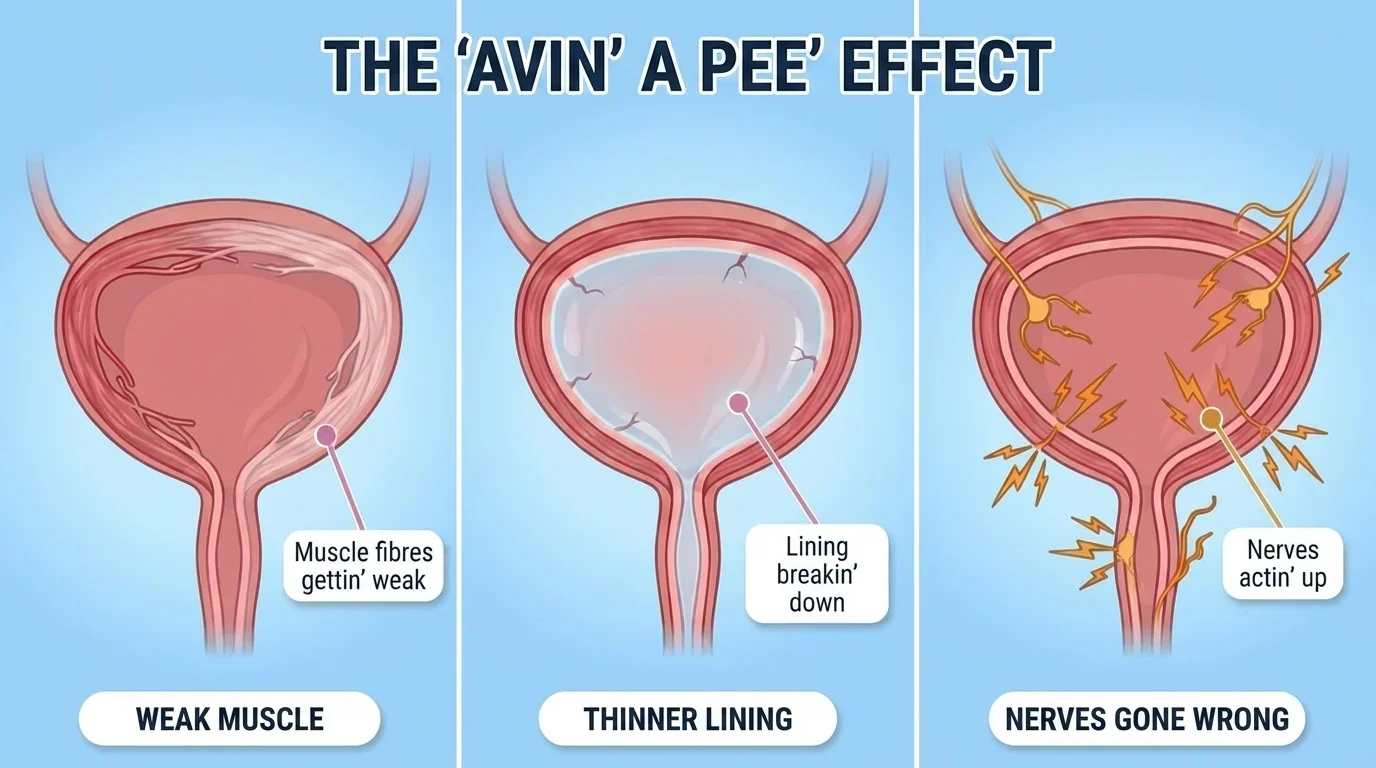
The entire treatment approach for bladder problems is built on a fundamental misunderstanding.
Not incompetence. Not ignorance.
A misunderstanding that just happens to be incredibly profitable to keep alive.
Here's what the research actually shows:
The real cause of bladder leaks, sudden urges to rush to the toilet and interrupted sleep in women over 55 has nothing to do with age.
It also has nothing to do with previous childbirths, body weight or how faithfully you've done your pelvic floor exercises.
The real cause is something so simple that I felt sick when I finally understood it.
The starved bladder effect
As you get older, your body gradually shifts into a type of survival mode.
It starts redirecting nutrients — magnesium, important minerals and essential fatty acids — away from lower-priority organs to protect the ones it sees as most important.
Your bladder sits right at the bottom of that priority list.
And when your bladder no longer receives the nutrients it needs to function properly, three systems begin to fail at the same time.
1. Weakening of the bladder muscle
It can no longer hold properly under pressure. It can't empty completely when you go to the toilet. That's why you may experience bladder leaks when you sneeze. It's also why you often feel like you haven't fully emptied your bladder.
2. Thinning of the bladder lining
The protective inner wall — the barrier between urine and the sensitive tissue underneath — starts to weaken. Urine comes into contact with tissue it was never meant to touch. That's what creates that burning sensation and sudden urge to go to the toilet. That feeling that you need to go immediately, even though your bladder is barely a quarter full.
3. Faulty signals from the bladder nerves
The signals between your bladder and brain start being sent at the wrong times. That's what wakes you up at 3 a.m., even when there's very little in your bladder. That's what creates that feeling of panic twenty minutes after your last trip to the toilet.
Three systems. All lacking nutrients. All failing at the same time.
And here's the part that made me furious when I finally understood it:
It's a vicious cycle.
The bladder muscle weakens → you experience bladder leaks → the bladder lining becomes thinner → irritation gets worse → the nerves send faulty signals → the urge to go to the toilet becomes stronger → the bladder muscle weakens even further.
Again and again. And worse with every cycle.
The healthcare industry has known about this nutrient redistribution process for years.
But here's the problem with a woman who has been buying incontinence pads and liners for ten years:
She represents around A$3,000 in revenue every year.
You can work out the rest for yourself.
Why everything you've tried hasn't worked.

I want to be completely honest with you about something. Nothing you've been told to do was ever going to solve the problem.
Not because you were doing it the wrong way.
Not because you gave up too soon.
But because every one of those solutions was aimed at the wrong problem.
Not one of them — not a single one — was ever designed to deal with what is actually happening inside your bladder. And the people who recommended or prescribed them knew that.
Pelvic floor exercises
Pelvic floor exercises strengthen the muscles in your pelvic floor that you can consciously control. They don't provide nutrients to your bladder. The bladder muscle, bladder lining and nerves don't become weaker because you've stopped exercising them. They become weaker because the nutrients they need are being redirected elsewhere in the body. You can't strengthen a muscle that isn't getting the nourishment it needs. It's like asking someone who hasn't eaten for three weeks to go for a run. The problem isn't a lack of effort. The problem is a lack of fuel.
Anticholinergic medications (Oxybutynin, Tolterodine)
These medications block the signal that creates a sudden urge to go to the toilet. They do nothing to address the underlying nutrient deficiency. They don't rebuild the bladder lining. They don't help the nerves function normally again. When people stop taking them, the symptoms often return — because the root cause hasn't been addressed. In women over 60, long-term use has also been linked to faster cognitive decline and a higher risk of dementia. The very group most commonly prescribed these medications is also the group most vulnerable to their effects on the nervous system.
Drinking less water
Your kidneys keep working around the clock, regardless of how much you drink. When you reduce your fluid intake, the urine you produce becomes more concentrated — making it more acidic, more irritating and more stressful on an already sensitive bladder lining. A bladder that receives too little fluid and becomes more irritated doesn't become calmer. In many cases, it becomes worse.
Pads and liners
Around A$3,000 a year. Bought in silence. Sometimes hidden among other items in an online shopping basket. This is not a treatment. It's an ongoing expense for a problem that may not need to be permanent.
None of these treatments address the real cause of the problem.
As long as the bladder muscle isn't getting the nutrients it needs, the symptoms will continue to come back.
Three things your bladder needs — and why it's not getting any of them
Once I understood the starved bladder effect, the solution became almost embarrassingly obvious.
This vicious cycle has three points where things start to break down.
All three need to be addressed at the same time — otherwise the cycle simply continues.
Step 1 : Nourishment
Give your bladder muscles the minerals they've been missing. Stop the leaks right at the source.
Step 2 : Restoration
Rebuild the protective lining so urine stops irritating tissue it was never meant to touch.
Step 3 : Recalibration
Reset the nerve signals so your bladder stops sending false alarms when there's nothing there.
If even one of them is missing, you're wasting your time.
That's why pelvic floor exercises don't work. (Effort without nourishment.)
That's why anticholinergic medications don't work. (Blocking signals without rebuilding the tissue.)
That's why cutting back on fluids often makes the problem worse. (Concentration without restoration.)
You need all three. At the same time. In the amounts that the research actually points to.
And that's exactly what I spent two years developing.
The formula I developed to address what the healthcare system didn't.

I wasn't satisfied with simply understanding the mechanism.
I wanted to create something that could actually break the cycle.
So I went back to the original research. The studies that often don't receive much attention once commercial interests move elsewhere.
And that led me to this:
To strengthen the bladder muscle
Pumpkin Seed Extract — Strengthens the bladder muscle
A randomised trial showed a significant reduction in bladder leaks caused by coughing, laughing and movement.
Magnesium Citrate — Stabilises muscles and nerves
A landmark study published in the Australian Journal of Obstetrics and Gynaecology found that magnesium significantly reduced urinary urgency and frequent nighttime urination. It regulates the calcium channels that control bladder muscle contractions — replacing uncontrolled activity with a calm, voluntary response, rather than the frantic signalling that has you rushing to the bathroom at two in the morning.
To rebuild the inner lining of the bladder wall
Sodium Hyaluronate — Direct restoration of the mucosal lining
A key building block of the bladder's protective mucosal lining. European clinical trials show clear improvements in urinary urgency and bladder wall integrity. It is one of the closest things available to direct support for rebuilding the thinned layer that allows urine to irritate the underlying tissue.
Cranberry Extract — Protective coating on the surface
Proanthocyanidins reduce inflammation in the bladder wall and form a protective coating over the epithelial cells. This makes the surface less reactive, less irritable, and less prone to the false alarm signals that create constant urgency without any real cause.
To restore hormonal and mucosal balance
Red Clover Extract — Supports the hormonal environment
Isoflavones that activate oestrogen receptors in the bladder wall and urethra. Randomised trials show reductions in urinary urgency, frequency, and tissue deterioration in post-menopausal women — without the risks associated with hormone replacement therapy.
Sea Buckthorn — Repairs the mucosal lining of the urinary tract
One of the few plant-based sources of omega-7 fatty acids, which are essential for the thickness and health of the mucosal lining throughout the urinary tract. Scandinavian research documents clear improvements in urogenital mucosal health with regular supplementation.
Six ingredients. Three functions. One vicious cycle — broken.
For twenty years, I told women that bladder problems were something you had to learn to live with, not something that could be solved.
I was wrong.
The breakthrough that's making an entire industry nervous.

The first person I gave it to was Margaret.
She came back seven weeks later.
I almost didn't recognise her — not because of how she looked. It was the way she was sitting. Upright. Relaxed. Like a woman who hadn't spent every minute since walking through the door thinking about how quickly she could get to the nearest toilet.
She told me she'd joined her church choir again. Not to listen.
To sing.
She sat in her usual seat next to Lorraine. Not once did she get up during the two-hour service.
She told me she'd driven to visit her daughter in Brisbane — without planning stops around where the toilets were along the highway. She simply got in the car and drove. Without even thinking about it.
She told me she'd slept through the entire night — properly and deeply — for the first time in four years.
"Why has nobody ever told us this?" she asked.
I gave her the honest answer.
There's no financial incentive to tell people. No pharmaceutical company spends money raising awareness about restoring the bladder's nutritional balance. The research exists — and has existed for years — but it's buried in journals that most GPs never read and that most women never discover for themselves.
So women keep buying pads and liners. Cancelling plans. Waking up at 3 a.m. And watching their world grow smaller year after year — because people like me told them that's just what getting older feels like.
After Margaret, I gave it to another twelve patients. Then thirty. And then word started to spread.
A retired school principal who hadn't taken a long-haul flight in six years. A grandmother who had stopped sitting in the front pews at her local church. A woman who had quietly moved into the spare bedroom so her husband could sleep through the night.
Every one of them improved.
Not improved in the sense that they "learned to live with it".
Not improved in the sense that they were "coping a little better".
Actually. Noticeably. Better.
That's when the letters started arriving.
When you challenge a billion-dollar industry, resistance doesn't take long to appear.

A colleague I'd worked alongside for eleven years pulled me aside during a medical conference in Sydney.
"Susan, what you're proposing challenges years of established clinical guidelines. You need to be very careful."
She hadn't asked to see a single patient outcome.
She hadn't reviewed a single study on the ingredients.
She just wanted me to keep quiet.
Then the formal complaints started. Two anonymous reports — both were dismissed.
Not long after that, the manufacturing partner who had been producing the formula for six years suddenly told us they could no longer fulfil our orders. No real explanation. Apparently, it was a decision from senior management.
Then came the offer.
From an investment firm.
An amount of money that would have made the rest of my career very comfortable.
On one condition: the formula could never be released to the public.
They wanted it buried.
I told them exactly what I thought of that idea.
Because here's what they hadn't counted on:
I'd already partnered with an Australian manufacturer that believed in the mission.
So I finished what I'd set out to do.
Meet the formula that actually makes a difference.
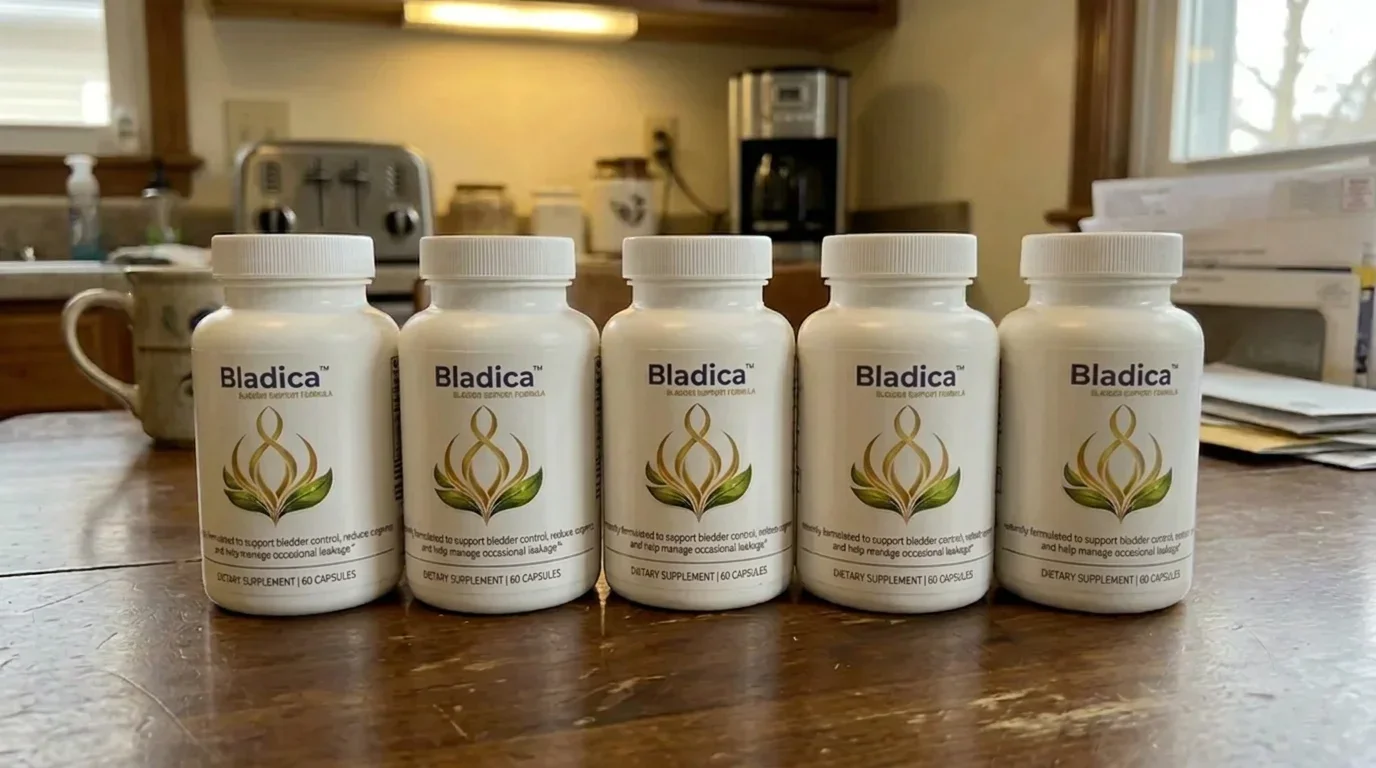
It's called Bladica™.
And it's the only formula I've found that actually breaks the cycle — all three stages of it — at the same time:
Provides the bladder muscle with the minerals it has been missing for years.
Helps rebuild the protective bladder lining, so urine is no longer coming into contact with tissue it was never meant to touch.
Supports healthy nerve signalling, so your bladder no longer wakes you at 3 a.m. without a real reason.
All three. At the same time. In clinically studied amounts.
Two capsules with breakfast. No prescription. No referral from a GP. No specialist telling you to "come back in three months" while your bladder lining continues to weaken.
Just a bladder finally getting the nourishment it has been missing.
Here's exactly what you can expect.
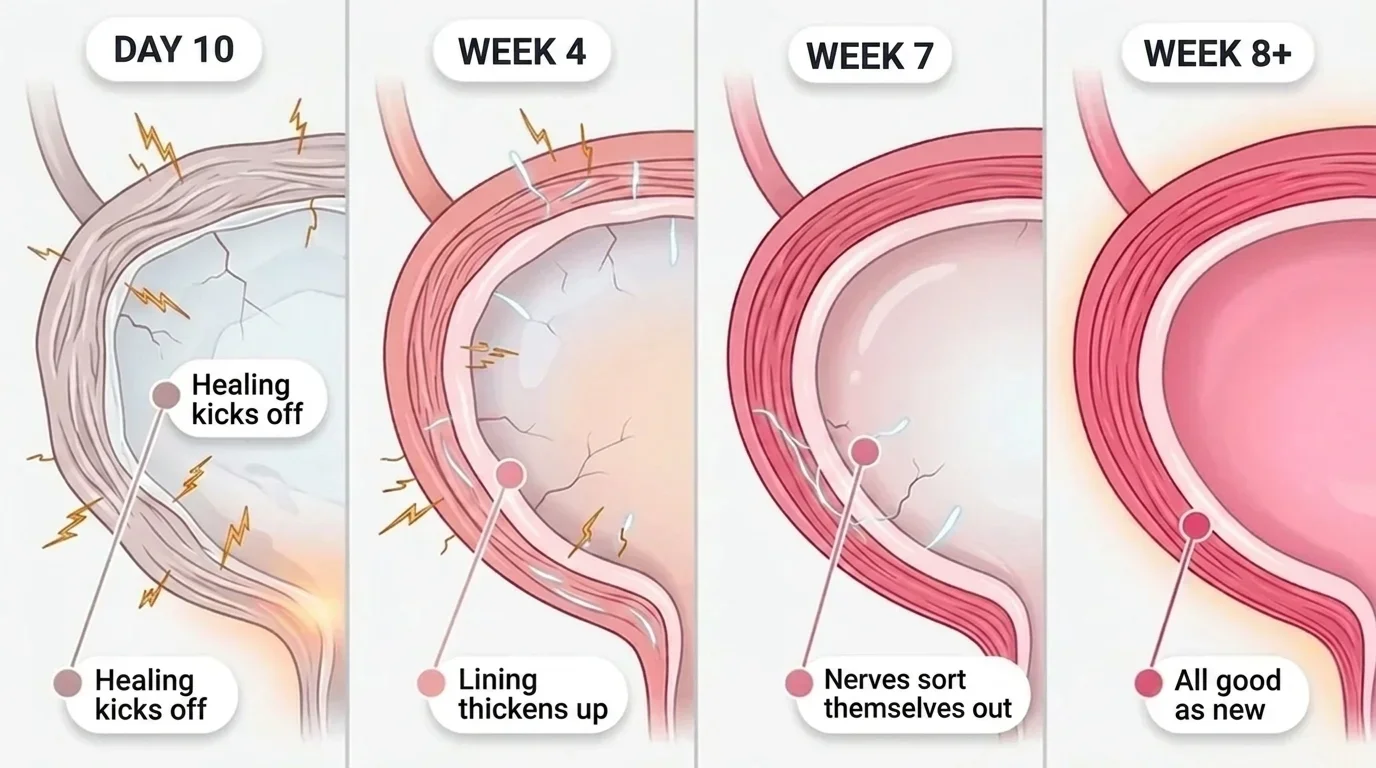
The most important thing I tell every woman before she starts is this: This is a biological rebuilding process, not a product that simply masks symptoms. You're restoring something that has gradually weakened — in some cases over many years. Results develop gradually over several weeks, which is why the full 30-day period is important.
Day 1–10: The foundation
Most women don't notice much yet — and that's completely normal. Magnesium begins helping to stabilise nerve signals to the bladder. Pumpkin seed extract begins reaching the muscle fibres. The body gradually builds the foundation it needs. Don't judge your results at this stage.
Week 2–4: The first signs of progress
The first noticeable improvements begin to appear. Women often report waking up one less time during the night. Sudden urges to rush to the toilet become less frequent and less intense. Many women describe leaving the house without planning their route around toilet locations for the first time in years.
"I just walked out the front door," one woman told me. "I didn't even think about it."
Week 5–7: The turning point
Your bladder stops running your daily life. Bladder leaks during everyday activities become occasional rather than constant. Women return to activities they had quietly given up — trips to the theatre, long drives and clothing they no longer felt comfortable wearing. Sleep becomes more consistent. Confidence starts to return.
Week 8: Freedom
The most common thing women tell me is essentially the same thing, just in different words: They stopped thinking about their bladder.
Not because they learned to live with the problem.
Not because they found ways around it.
They simply stopped thinking about it.
For any woman who has spent years planning her life around this issue, that change is far bigger than it sounds.
The price that's making the healthcare industry panic.

Let me show you what it actually costs to "manage" this problem. Not what the public health websites say. But what it really costs.
Pads and liners
Bought in silence.
Year after year. Indefinitely.
Your bladder doesn't get better — it gradually gets worse.
Cost: around A$3,000+ per year
Prescription anticholinergic medications
Oxybutynin, Tolterodine.
Side effects included at no extra cost.
And when you stop taking them, the symptoms often return.
Cost: around A$150–A$300 per month
Private bladder surgery
A recovery period that can take several months.
A success rate that very few clinics are willing to guarantee in writing.
Cost: around A$9,000–A$15,000
The healthcare industry loves these solutions. Because you keep coming back.
Bladica™ should cost around A$300 per month — that's what it would actually cost to buy all six ingredients separately in clinically relevant amounts from reputable suppliers.
But I didn't develop this to make money.
I developed it on the afternoon when Margaret sat across from me and told me she hadn't been to choir practice in three years.
Because of the challenges involved in sourcing some of the ingredients, the standard price of Bladica™ is A$39 for 1 bottle.
But because my highest priority is helping women who have been struggling with this problem for a long time.
Here's what you'll pay today: A$39.
Less than the cost of a single GP appointment.
Less than six weeks' worth of prescription pads and liners.
Less than a course of pelvic floor physiotherapy that didn't address the underlying cause.
And you can get it all by "CLICKING THE BUTTON".
My personal 30-day "No more worrying about your bladder" guarantee

Listen, I completely understand where you're coming from. You've tried things before. You've done the pelvic floor exercises. You've taken the tablets that left you with a dry mouth and made it harder to think clearly. And you've spent good money on supplements that, in the end, didn't really make a difference.
So here's my promise. Try Bladica™ for 30 days. Take it every morning with breakfast. Two capsules. Nothing more than that.
Notice how those sudden urges to rush to the toilet become less frequent. Notice how a good night's sleep starts to return. Notice how you leave the house without thinking about where the nearest toilet is.
And if one morning you don't catch yourself thinking, "When did I actually stop worrying about this?" — simply send the bottles back. Even if they're empty. You'll receive a full refund. No forms. No approval codes. No frustrating customer service scripts.
Just provide your order number. That's it.
Why am I so confident?
Because our refund rate is less than 3%. Not a single pharmaceutical company — not one — has ever offered the women I've treated a guarantee like this.
Not once.
In twenty years.
I think that tells you everything you need to know about who truly stands behind the results.
The choice that could shape the next ten years of your life.

Right now, you're standing at a crossroads.
Option 1 — Keep doing what you've always done
Keep buying pads and liners in silence. Keep planning every outing around where the nearest toilet is.
Keep waking up at 2, 3 or 4 in the morning — even when your bladder is almost empty.
Keep missing out on front-row seats, long road trips, choir rehearsals and your grandchildren's school performances.
Keep telling yourself that this is simply part of getting older.
Keep being worth around A$3,000 a year to someone else's business.
Option 2 — Address the real problem
Give Bladica™ 30 days. Work on all three stages at the same time.
Experience what it's like to leave the house without a plan.
To sleep right through the night. To sit in the front row.
To stop thinking about your bladder all the time.
To feel like yourself again.
To me, the choice seems pretty simple.
I know what I'd choose.
And I know what Margaret would tell you to choose — the woman who returned to her church choir, who sat beside Lorraine, who didn't get up once during a two-hour service, and who later asked me why nobody had told her about this sooner.
Here's exactly what you need to do now.

Click the button below that says "Claim your discount →"
Choose the package that suits you best. A helpful tip: Choose the 3-month package at around A$39 per bottle. It's the complete program — the full process designed to break the cycle. One month gives you a starting point. Three months gives you the opportunity to get your everyday life back.
Enter your delivery details. If you place your order before 3:00 p.m., we'll dispatch it on the next business day.
Allow 3–5 business days for delivery.
Take your first capsule tonight.
Send us a message when you have your first "it actually worked" moment. Seriously. Our customer support team can be contacted at: support@vitalhealthfacts.au
But whatever you do — don't close this page thinking you can come back later.
Later doesn't exist when every day feels like you're not in control of your bladder.
Later is another night of interrupted sleep.
Your bladder has gone without the support it needs for long enough.
Click the button and take the first step today.
Kind regards,
Dr Susan Mitchell — the urologist who spent twenty years giving the wrong answer, and the last two years working to put it right.
P.S. — I've just returned from a long weekend in the Blue Mountains with my husband. We left on Friday evening — stopping only once to fill up the car. On Saturday, we walked almost 15 kilometres. And I slept right through both nights without interruption. It really can be that simple. In just a few weeks, that could be you too. But only if you take action now.
P.P.S. — Bladica™ is manufactured in a GMP-certified facility that meets strict Australian and international quality standards, and every batch is tested by an independent laboratory for purity and quality. Every ingredient is clearly listed on the label. No proprietary blends. No unnecessary fillers. No artificial additives.
P.P.P.S. — We only have a limited number of units available at this price. Once stock falls below the allocated level, this page will be removed and the price will return to A$99 per bottle. You can't say you weren't warned.
Get an extra 50% off – while stocks last.
This offer is extremely popular, and stock levels can change quickly.
We can't guarantee that Bladica™ will be available again at this price once current stock sells out.
Risk of selling out: High
🚚 Free shipping

Margaret Wilson
I was honestly sceptical. I'd tried everything, and nothing had worked long term. But after about five weeks of using Bladica, I started sleeping through the night, and those sudden urges to rush to the toilet became much less frequent. This morning, I actually left the house without even thinking about where the nearest toilet was. That hasn't happened in years.

Lorraine Parker
Same experience here. I was waking up two or three times every night and planning all my outings around where the toilets were. I decided to give Bladica a proper chance, and by week four I could already notice a clear difference. I slept through until 6 a.m. without interruption for the first time in about three years. My husband noticed it before I did!

Peter Thompson
I'd been dealing with sudden toilet urges and bladder leaks for around four years. My GP kept recommending pelvic floor exercises and drinking less water, but nothing changed. Since starting Bladica, everything feels different. The urgency has settled down considerably, and I'm no longer rushing to the toilet every hour. I'm really glad I found it.



Recommended:
★★★★★
⭐ 4.8 | 13,420 reviews


Bladica™

Quickly helps restore better bladder control
Helps stop sudden urges to rush to the toilet and supports a more restful night's sleep
Recommended by Australian urologists and women's health specialists
Clinically proven and laboratory-tested formula made with natural ingredients
The information on this page or in the related materials is not intended as medical advice and does not replace professional diagnosis or treatment from a qualified medical professional.
If you or someone else has a health concern, we recommend seeing your GP or another qualified health professional.
Professional medical advice should never be ignored or delayed based on the content of this page or any related materials.
If you believe you are experiencing a medical emergency, call your doctor or dial 000 immediately.
© 2026 All rights reserved.
Privacy Policy · Terms of Use